Top 5 Mistakes to Avoid When Building a House in Nepal
Introduction: Why Smart Planning Matters
Building a house in Nepal is a once‑in‑a‑lifetime dream for most families. Yet soaring material prices, unpredictable weather, and layers of municipal regulation mean that one wrong step can inflate costs or delay possession by months. At Skyroof Engineering Groups Pvt. Ltd., we’ve supervised 100+ residential projects across Kathmandu Valley and seen the same five pitfalls ruin otherwise beautiful builds. Planning to build a house in Nepal? This guide will help you understand everything from budget planning to permits.
Mistake 1: Skipping a Detailed Soil & Site Analysis
Kathmandu sits in an ancient lakebed; Bhaktapur and Lalitpur perch on mixed clay and sand; Pokhara sits on alluvial fans—each soil type reacts differently to monsoon rains and seismic activity.
- Consequence: Inadequate soil bearing capacity leads to uneven settlement, cracking beams, and expensive retrofits.
- Solution: Invest in a geotechnical survey before finalising your design. A standard bore‑hole test for a building 5 storeys or more costs between NPR 35,000–65,000, a fraction of what foundation failure will cost later.
- Pro Tip: Pair soil reports with a seismic vulnerability assessment—mandatory in Kathmandu Metropolitan City since the 2022 building code update.
Mistake 2: Underestimating Permit Timelines & Hidden Fees
Municipal approvals in Nepal require stamped architectural drawings, structural analysis reports, property tax clearance, and a neighbourhood consent form (ghar sancho) in certain wards.
- Typical timeline: 4–8 weeks in Kathmandu, 10–12 weeks in rapidly urbanising municipalities like Budhanilkantha.
- Hidden fees: Document attestation, ward inspections, and mandatory NRs 5–15 per square foot “urban service charge.”
- Fix: Engage a licensed civil engineer or a Category ‘A’ consulting firm (like Skyroof) to shepherd files through the digital e‑Building Permit system. We cut average approval time by 30 %.
- SEO angle: Searchers looking for “building permit Kathmandu” will land here; internal‑link to your “Services → Permit Processing” page.
Mistake 3: Focusing on Up‑Front Material Cost Instead of Lifecycle Value
Tempting low‑price offers on steel, cement, or window frames often hide quality compromises that triple maintenance costs.
| Material | Cheap Option | Premium Choice | Long‑Term Savings |
|---|---|---|---|
| Rebar | Fe415 TMT | Fe500D earthquake‑resistant | 15 % less steel needed; +10 yrs durability |
| Cement | Ordinary Portland | PPC with fly‑ash | 20 °C lower heat of hydration = fewer cracks |
| Windows | Powder‑coated MS | uPVC/toughened‑glass | 30 % energy‑bill reduction |
Note: Kathmandu electricity tariff crossed NRs 12/unit in 2024, so energy efficiency is a big deal.
Action Step: Ask suppliers for Nepal Standard (NS) certification and a 5‑year warranty. The few extra rupees per bag of cement save lakhs in waterproofing later.
Mistake 4: Neglecting Integrated Design & BIM Coordination
Using separate architects, structural engineers, and MEP (mechanical, electrical, plumbing) contractors without an integrated 3D model triggers clashes—think beams cutting through ductwork.
- Stat: A 2023 Society of Nepalese Architects (SONA) study showed 18 % average cost overrun in projects without Building Information Modeling.
- Skyroof insight: Our BIM workflow detects conflicts at the drawing board, not on the slab, cutting change orders by 42 %.
- DIY Tip: Even if your budget won’t stretch to full BIM, insist on at least a coordinated Revit or ArchiCAD model with clash‑detection screenshots during design review meetings.
Mistake 5: Ignoring Futureproofing—Energy, Expansion & Resale
A house should last generations, so think beyond today’s floor plan.
- Structural Expansion Joints: Kathmandu bylaws now allow vertical extension only if the original columns and footings were sized for extra load. Over-size rebar today to avoid tearing down tomorrow.
- Solar-Ready Roofs: Installing conduit sleeves and a south-facing pitch during construction costs under NRs 25,000—retrofitting later costs three times as much.
- EV Charging: Home EV adoption in Nepal rose 65 % in 2024. A simple 32 A conduit near the parking slab protects resale value.
Takeaway: Design flexibility raises resale price by 10–12 % in urban wards, according to Nepal Land & Housing Developers’ Association.
Conclusion: Build Smart, Build Secure
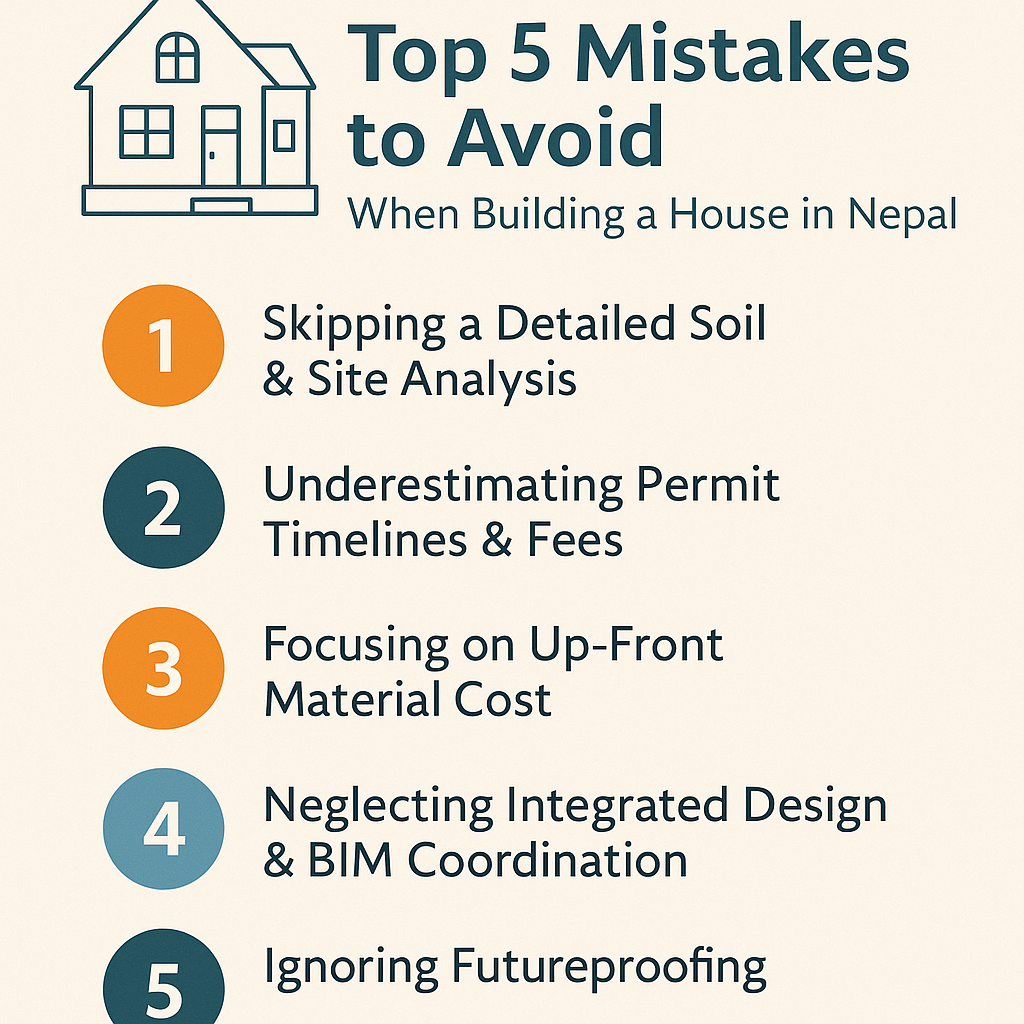
Avoiding these five mistakes—site misjudgment, bureaucratic delays, cheap materials, uncoordinated design, and short‑sighted planning—can shave months off your construction timeline and save lakhs of rupees. Skyroof Engineering Group offers end‑to‑end solutions: from soil testing and BIM design to permit processing and green construction.
Ready to break ground? Contact our team for a free 30‑minute consultation.